
Strengthening the way food systems are governed
A practical, evidence-based framework for assessing how effectively whole-of-government and whole-of-food system institutions govern food systems — helping governments and their partners see what is working, what to strengthen, and how to prioritise reform.
What the Food System Governance Strengthening Framework is
The hardest barrier to better food systems is rarely a shortage of policies or technical solutions — it is governance itself. Responsibility sits across many ministries and actors, interests and ideas conflict, and power is unevenly held, so policies in one sector routinely undermine another's [1-3]. To address this, a growing number of governments have established whole-of-government or whole-of-food system governance institutions: councils, committees, working groups, or coordinating ministries tasked with steering food systems and bringing state and non-state actors to the same table [4-5].
Establishing one, however, is only the beginning. The harder questions are whether it changes how actors work together, whether that produces more coherent policy, and where it could be strengthened.
The Food System Governance Strengthening Framework is the first practical framework for assessing how effectively multisectoral, government-led institutions govern food systems, strengthening those that exist, and guiding the design of new, fit-for-purpose ones. It gives policy makers, development partners, researchers and others, a common language and a structured, evidence-based way to answer these questions.
What the Framework focuses on — and what it does not
The Food System Governance Strengthening Framework focuses on a specific type of institution: multisectoral, participatory bodies established to coordinate food system governance across sectors. These include government-led food system committees, food security and nutrition councils, technical working groups, and comparable inter-ministerial or multi-stakeholder structures.
The Framework does not focus on food regulatory agencies: These institutions, such as national food standards agencies, set and enforce standards within a defined domain — food safety, labelling, permitted additives, contaminant limits, compositional requirements — largely translating Codex Alimentarius provisions into national rules. Their remit is deliberately narrow and their authority is regulatory. In contrast, the multisectoral and/or participatory food system governance institutions in focus of the Framework are primarily coordinating bodies. Their purpose is to bring agriculture, health, trade, environment, social protection, etc., and non-state actors around a common table, so that decisions taken in separate ministries pull in the same direction. The Framework helps understand how well an institution performs that coordinating role, such as its inclusiveness, its convening authority, its capacity to reconcile competing mandates.
The Framework does not aim to cover a complete food system governance system assessment: The Framework focuses on a multisectoral and/or participatory food system institution, not on the entire national food system and its governance. It does not undertake stakeholder mapping, policy landscape mapping, or a full analysis of a country’s food system governance mechanisms. Our team does carry out comprehensive food system governance assessments of this kind, and we welcome enquiries from governments and partners interested in them — please get in touch.
If your interest is in strengthening a specific multisectoral and/or participatory food system governance institution, read on.
How we developed it
The Framework is grounded in systems thinking and built to be both rigorous and replicable in any country. It was developed through a structured, multi-step co-design process:
a scoping review of 88 existing governance evaluation frameworks;
a two-round Delphi validation with more than 70 policy practitioners from over 50 countries;
pilots with national institutions in six countries — Brazil, Cambodia, Somalia, Timor-Leste, Yemen, and Zambia — spanning different food system types, institutional designs, and fragile, conflict-affected settings.
An International Advisory Group drawn from FAO, WFP, UNDP, CGIAR, and universities across Latin America, Europe, Africa, and Asia and the Pacific guided the work throughout.
Countries represented during the co-design process of the Food System Governance Framework (Note: due to confidentiality reasons, not all participating countries are represented in the map.)
The Theory of Change
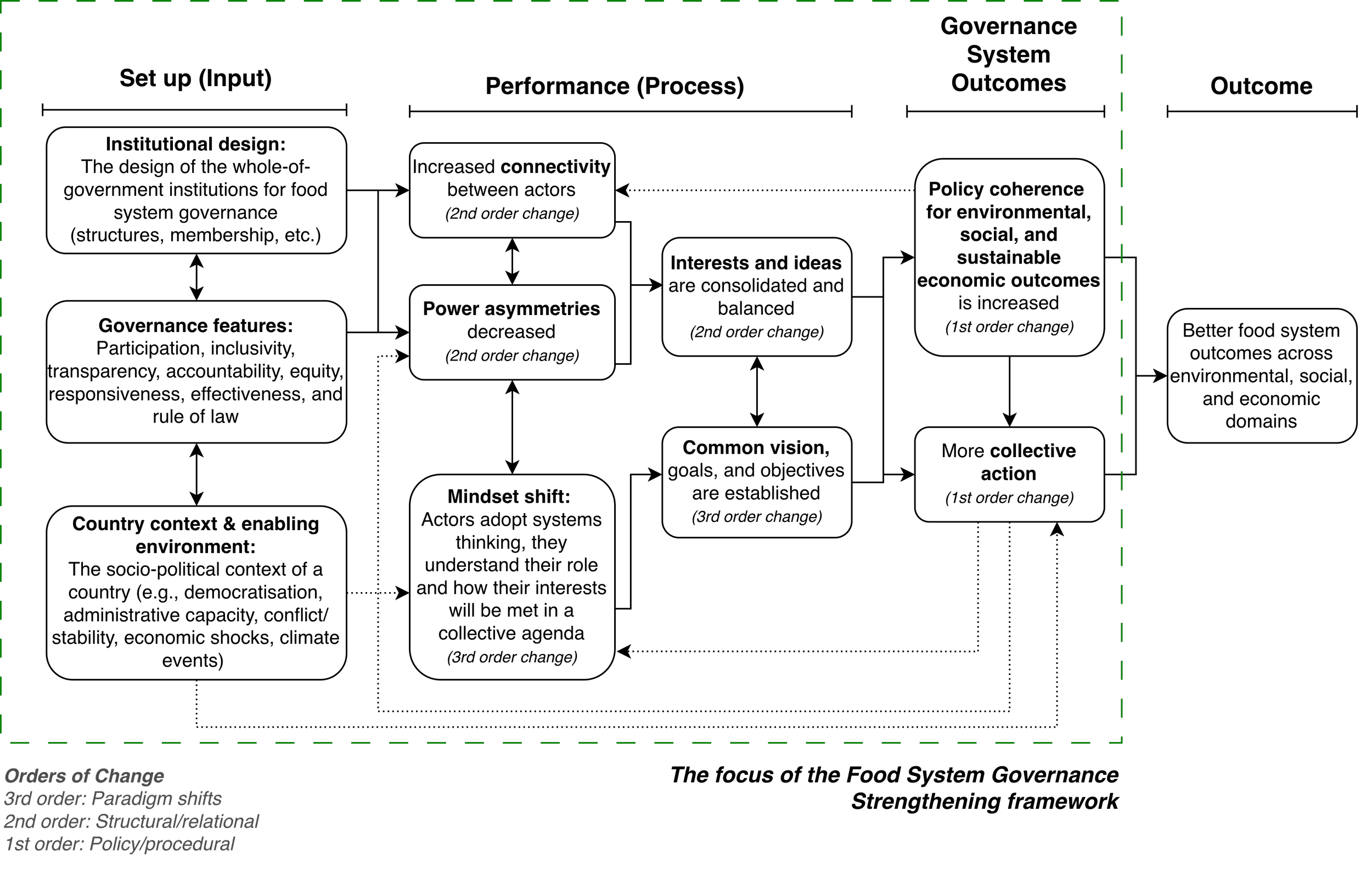
The Framework traces how a governance institution creates change across three linked stages:
Set-up (inputs). How the institution is designed — its mandate, decision-making power, who convenes it, who participates, its resources — and how well it reflects good-governance principles in its national context.
Performance (process). What changes once it is working: greater connectivity between actors, reduced power asymmetries, a shift toward systems thinking, and shared goals and vision across sectors.
Governance-system outcomes. What this produces: greater policy coherence across social, environmental, and economic goals, and more collective action across government.
Over the longer term, stronger governance is expected to improve food system outcomes themselves — but many factors shape those, so the Framework concentrates on the links it can credibly evaluate, from set-up through to governance system outcomes.
The Framework's Toolkit turns the Theory of Change into practice — six instruments grounded in a shared Theory of Change. The Framework is the way of thinking; the Toolkit is the set of instruments that operationalise it.
References:
Béné, C. (2022). Why the Great Food Transformation may not happen–A deep-dive into our food systems’ political economy, controversies and politics of evidence. World Development 154: 105881.
Schneider, K. R., et al. (2025). Governance and resilience as entry points for transforming food systems in the countdown to 2030. Nature Food 6(1): 105-116.
FAO (2025). Transforming food and agriculture through a systems approach. Rome, Italy, Food and Agriculture Organization of the United Nations (FAO).
Patay, D., Reeve, E., Thow, A.M., Baker, P., Farrell, P. (2025). Whole-of-food system governance for transformative change. Nature Food, 6(7), 636–640. doi:10.1038/s43016-025-01196-x.
Patay, D., Rippin, H., Ares, G., Reeve, E., Venegas Hargous, C., Farrell, P., Reeve, B., Vivero-Pol, J.L., Thow, A.M. (2025). From Ministries of Food to National Food System Committees: a global mapping and typology of multisectoral food system governance institutions. Sustainable Development, 1–21. doi:10.1002/sd.70320